


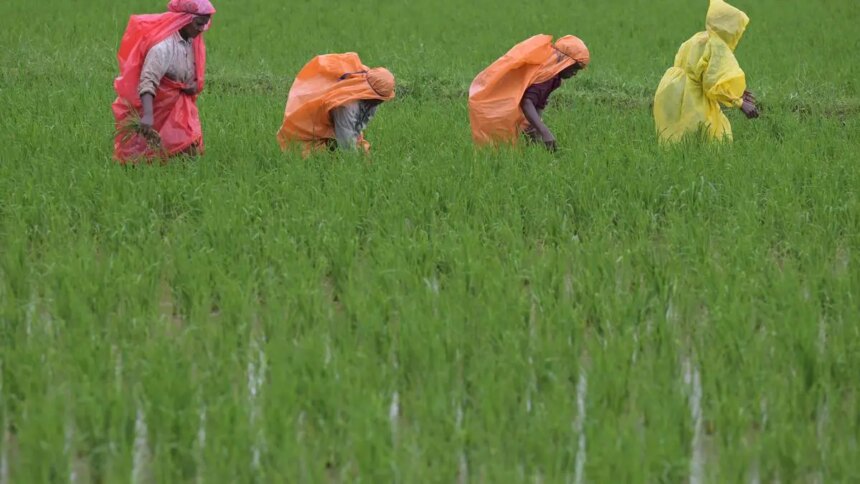
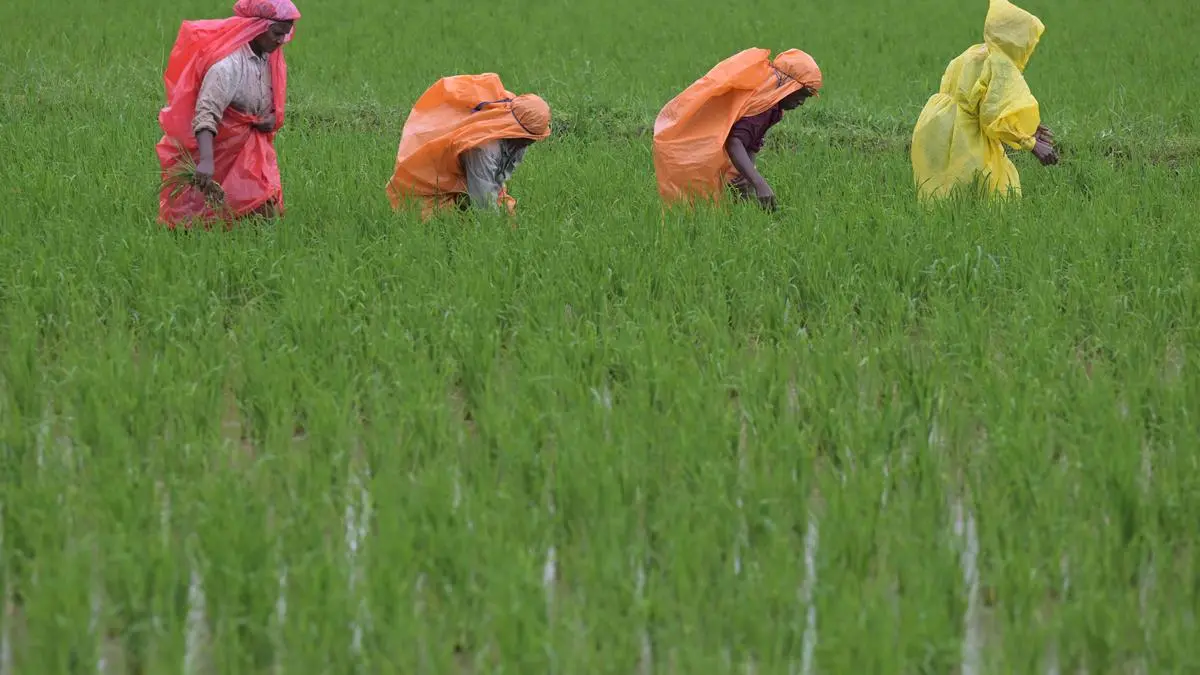
Deficient rainfall in rain-fed areas can impact farm output
| Photo Credit:
K K Mustafah
The India Meteorological Department’s (IMD) recent forecast of an above normal south west monsoon (SWM) augurs well for the kharif crop. If the projection of 105 per cent of the long period average of 87 cm turns out right (it does, more often than not), it would mark the second straight year of above normal SWM rainfall. Looking back at last year, IMD’s October 2024 review of the SWM estimated the June-September rainfall at 108 per cent of the LPA. Favourable late-season rainfall has a salutary effect on rabi crops as well. Not surprisingly, growth in agriculture GVA was a healthy 4.6 per cent for FY25. Yet, for monsoon forecasts to benefit all crops and regions, the projections should improve at a district or taluk level.
Localised forecasts have become important, given the large spatial and temporal variations in rainfall. A March 2025 Reserve Bank of India paper on agriculture and monsoons observes that in 2024, the SWM was normal in 304 districts against 350 in 2023, deficient in 148 (212) and excessive in 220 (110). At the same time, 59 districts that received normal rainfall in 2023 were deficient in 2024. A similar pattern would hold true for other years, with deviations from the mean being high. Therefore, a broad forecast of above-normal monsoon can mask pockets of deficient or excessive rainfall. If rainfall happens to be deficient in regions that are largely rainfed (50 per cent of cultivated area), it could have a pronounced impact on crops, even if in just a few pockets. This, however, could have an outsize effect on prices. This has been observed in the case of the so-called TOP (tomato, onion, potato) crops in particular, besides pulses and oilseeds. Therefore, researchers have observed a reasonably strong link between rainfall and overall agriculture GVA, but less so between good rainfall and food inflation.
The mid-season and short range IMD forecasts need to improve – more so because the monsoon these days is characterised by erratic and more intense spells of rainfall. This is easier said than done in times of global warming, when oceanic currents such as El Nino, La Nina and Indian Ocean Dipole and their interplay have become harder to predict. The IMD October review shows how its monthly estimates (June-September) varied from the norm.
However, technology and innovation have shown a way forward. Minister of State for Earth Sciences Jitendra Singh informed the Lok Sabha (March 12) that the Ministry has set up an AI/ML centre at the Institute of Tropical Meteorology, Pune. These could sharpen “short-range precipitation forecasts”. Start-ups are using AI/ML in district level weather data to predict rain and heat in smaller regions. Meanwhile, ICRISAT has launched an AI/ML-driven plant health indicator, an effort that can be dovetailed with emerging AI weather start-ups. Weather forecasting should become a collaborative ecosystem. This will help anticipate contingencies, while maximising opportunities on the basis of valuable information.
Published on April 18, 2025
About The Author